Online hate is often minimized. Adults may say: “don’t read the comments,” “ignore it,” or “it’s just the internet.” But for children and teenagers, the internet is not a separate world. It is a space where they build relationships, look for acceptance, compare themselves with others, express who they are and try to understand their identity.
That is why online hate does not end when a child turns off their phone. It can stay with them for a long time — in their self-esteem, relationships, body image, mood and mental health.
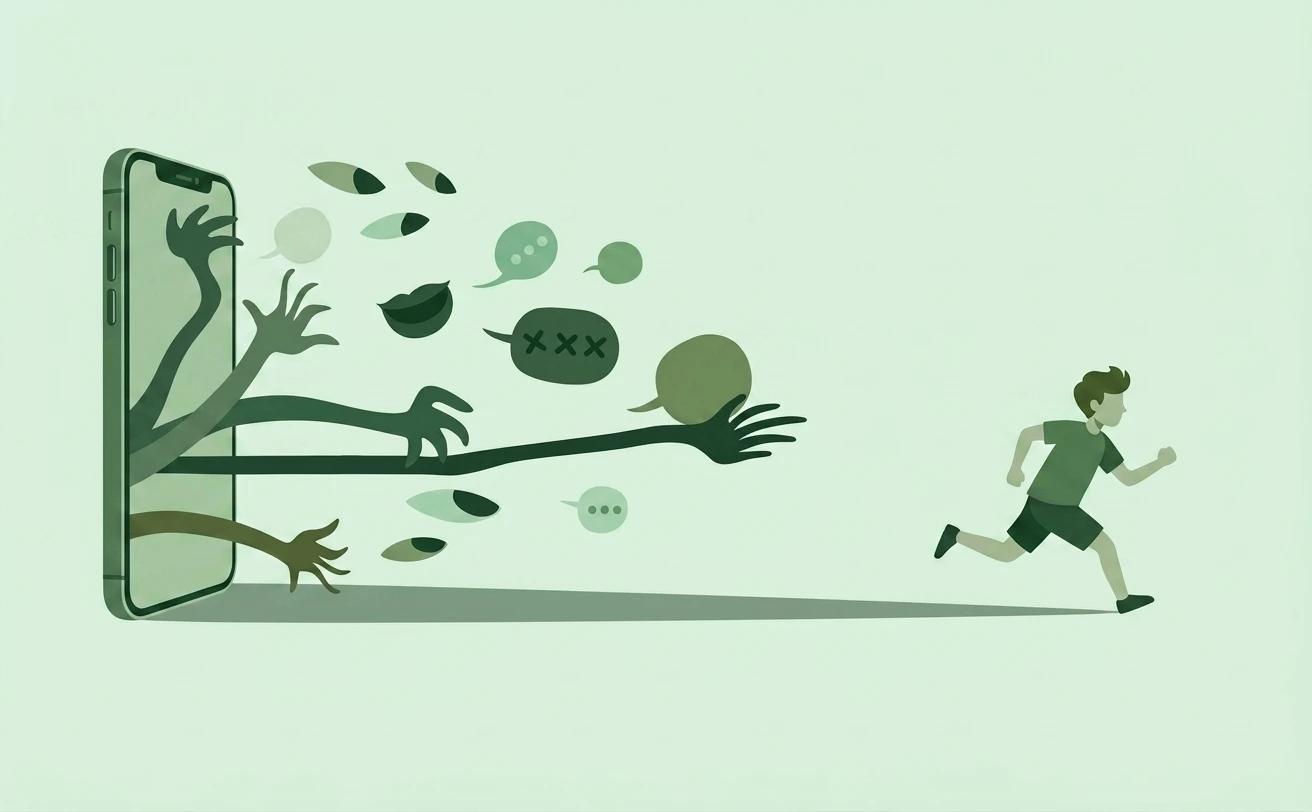
Hate Is Not “Just an Opinion”
Hate speech is not constructive criticism. It is a form of verbal violence intended to humiliate, shame, ridicule, exclude or hurt another person. It may appear as comments, private messages, memes, edited images, videos, classroom group chats or public mockery on social media.
The SWPS University report “Polish internet users and online hate 2019–2024” defines hate as offensive, aggressive and usually unjustified public criticism of a person or group, most often online. What matters is that hate differs from criticism because it lacks substantive value, relies on personal attacks, carries a negative intention and aims to cause harm.
Among children and teenagers, online hate often targets appearance, weight, clothes, background, sexual orientation, identity, school performance, financial status, disability, neurodivergence or simply being perceived as “different.”
The Scale of the Problem: Young People Are Especially Exposed
The data show that online hate is not a marginal issue. According to the 2024 SWPS report, 45% of Polish internet users had encountered online hate, and 28% had personally been publicly criticized, for example online or on forums. The youngest group is especially exposed: among people aged 15–24, as many as 66% had encountered online hate, and 48% had been publicly criticized (SWPS University report).
This is not only a Polish issue. A 2024 WHO/Europe report based on the Health Behaviour in School-aged Children (HBSC) study across 44 countries and regions found that one in six school-aged children experiences cyberbullying and that cyberbullying has increased since 2018, alongside the digitalization of young people’s social lives (WHO/Europe, 2024).
This matters because young people are not only recipients of hate. The same SWPS report shows that 37% of internet users admitted they had posted a critical opinion online, and among people aged 15–24 this figure rises to 46%. This means that young people function in an environment where it is easy to become a victim, witness and perpetrator of verbal aggression at the same time.
At the same time, 88% of respondents in the SWPS report consider online hate a serious social problem, and according to the SWPS press article, 90% believe it should be actively addressed. The problem is socially recognized — but effective ways to reduce its everyday presence online are still missing.
Cyberbullying Happens 24/7
Traditional peer violence was often connected to a specific place: school, the playground or a group of peers. Cyberbullying has no such boundaries. It can continue around the clock through comments, private messages, class group chats, stories, videos and reposts.
The OKO.press report “Szkoda, że jesteś” cites data showing that 47% of children did nothing after experiencing digital aggression. Young people “endure” name-calling, ridicule, humiliation and threats, while 66% of parents believe their child would come to them for help.
This is one of the biggest gaps in child protection: adults often believe they would know about the problem, but children do not always speak up. They are left alone with fear, shame and the feeling that no one can help them.
Psychological Consequences of Online Hate
Hate does not only affect a child’s temporary mood. It can attack their basic psychological needs: safety, belonging, acceptance and the feeling of being valued.
A child or teenager experiencing hate may feel anxiety, shame, humiliation, helplessness, loneliness, anger, guilt or low mood. It can show up as reduced self-esteem, reluctance to go to school, sleep difficulties, problems concentrating and social withdrawal.
Over time, online hate may increase the risk of more serious mental health difficulties, such as depression, anxiety disorders, self-harm, eating disorders or suicidal crisis.
International public health sources describe this link in similar terms. WHO notes that bullying — including online bullying — is highly prevalent and negatively affects health, especially mental health, and has been linked to depression, anxiety and suicidality, with potential effects lasting into adulthood (WHO Global Health Observatory).
Hate, Violence and Suicidal Crises
The most alarming data concern adolescent mental health. The report by the Dbam o Mój Z@sięg Foundation, “Good and bad news — online and offline life and the mental health of Polish teenagers,” shows that 25% of seventh-grade primary school students and 36% of third-grade secondary school students had thought about not waking up.
The same report indicates that 15% of seventh-grade students and 25% of third-grade secondary school students had experienced passive suicidal thoughts in the previous year. Particularly importantly, OKO.press cites the report’s data showing that 15% of seventh-graders had planned to take their own life, and 8% had attempted suicide.
The “Good and bad news” report also shows the relationship between violence and psychological crisis. According to data cited by OKO.press, as many as 99% of children who had considered taking their own life had experienced at least one of four types of violence: physical, psychological, sexual or peer violence.
This does not mean that online hate is the only cause of suicidal crises. Mental health crises are always complex and multifactorial. But the data are clear: violence, including peer and digital violence, can be one of the factors that deepens suffering and increases risk.
Global research points in the same direction. UNICEF Innocenti’s report “Childhood in a Digital World” states that children who experience online sexual abuse or online bullying have significantly higher levels of anxiety and more suicidal thoughts and behaviours (UNICEF Innocenti). A 2024 article in JAMA Network Open on nonsuicidal self-injury among adolescents also notes that social-media-related exposures — including cyberbullying and exposure to self-harm-related content — are associated with self-injurious thoughts and behaviours (JAMA Network Open, 2024).
Algorithms, Suicidal Content and Comments That Intensify Suffering
The problem is not only hate itself, but also the way platforms expose young people to content related to suffering, self-harm or suicide.
The Dbam o Mój Z@sięg Foundation report indicates that among seventh-grade children who had attempted suicide, 57% had been exposed to suicidal content online even though they had not searched for it. Among third-grade secondary school students, this figure was 41%.
OKO.press also describes examples of comments posted under resignation-related content shared by young people — such as “lol you won’t do it,” “bye” or “do it.” This shows that hate can function not only as humiliation, but also as an amplifier of crisis. When a teenager is communicating distress, a toxic comment can become an additional impulse that deepens hopelessness.
Hate and Self-Esteem
Children and teenagers are still building their self-image. What they hear from peers, followers or commenters can strongly influence how they begin to see themselves.
If a young person regularly reads that they are “ugly,” “fat,” “weird,” “stupid” or “worthless,” they may begin to treat these words as truth. Hate then becomes not only something happening outside them, but also an internal voice they start repeating to themselves.
This is especially dangerous during adolescence, when the need for social acceptance is very strong and self-esteem is often fragile.
Who Is Especially Vulnerable?
According to the SWPS report, Polish internet users believe that in 2024 the most frequently targeted group was sexual minorities — indicated by 63% of respondents. People with excess weight were also high on the list, with 57% of indications, alongside other less privileged groups.
This matters in the context of children and teenagers because online hate often targets exactly the areas that are most sensitive during adolescence: body, identity, belonging, sexuality, appearance, social status and the need for acceptance.
Why Children Often Do Not Ask for Help
Many young people do not tell adults about the hate they experience. The reasons vary: they are afraid their parents will take away their phone, they feel ashamed of what happened, they fear adults will not understand, they think “this is just how the internet works,” they do not want to be seen as weak, they fear adult intervention will make things worse, or they feel they have no control over what has already been posted.
This means that many children face online hate alone. And loneliness in the experience of violence often deepens its psychological impact.
Hate Is Not “the Price of Being Online”
One of the most harmful beliefs is the idea that hate is normal — that if someone publishes content, uses social media or is active online, they must accept verbal violence.
That is not true.
Online hate is not a natural part of the internet. It is a social, technological and psychological problem. Just as we respond to violence in schools, workplaces or public spaces, we should respond to violence online.
The point is not to cut children and teenagers off from the internet entirely. The point is to create digital spaces where young people can function without constant exposure to humiliation, hatred and toxic comments.
What Can Adults Do?
Parents, teachers and caregivers play a crucial role in protecting children from the effects of hate. The most important thing is to build a relationship in which a child knows they can talk about a difficult situation without fear of punishment, judgment or having their phone taken away.
Helpful steps include regularly talking about what happens online, not minimizing harmful comments, treating hate as a real form of violence, teaching children how to report and document cyberbullying, strengthening self-esteem, responding to signs of withdrawal, sadness or anxiety, cooperating with the school, and seeking psychological support when the situation affects a child’s mental health.
But conversation alone is not always enough. We also need tools that reduce the visibility of toxic content and decrease the scale of online violence.
How Technology Can Help
Technology is part of the problem, but it can also be part of the solution. If algorithms can amplify aggressive, controversial and harmful content, we can also create tools that help detect, filter and reduce its impact.
That is why ZenFeed was created — a tool that helps reduce hate and toxic comments online. Its goal is to support safer digital spaces by analyzing and filtering content that may be harmful, aggressive or humiliating, before the person on the receiving end has to see it.
ZenFeed can support schools, organizations, foundations, online creators, educational institutions, online communities, and people and projects working with children and teenagers.
ZenFeed is not meant to replace education, conversation or psychological support. It is meant to complement them. A child who returns every day to a toxic online space needs more than being told “you matter.” They also need an environment that does not amplify violence.
This is the same reasoning behind why comment sections feel toxic in the first place: visibility is not distributed evenly, and hostile comments tend to get amplified precisely because they provoke the strongest reactions — including from the youngest, most vulnerable readers.
Reducing Hate Is Mental Health Protection
Comment moderation is often treated as a technical issue. In reality, it is also a mental health issue. Every comment that humiliates, mocks or encourages violence can affect the person on the other side of the screen — especially when that person is a child or teenager.
Reducing hate is not about censoring sensitivity. It is about setting boundaries. Just as we do not accept violence in the classroom, we should not accept it in comments, messages and social media.
Conclusion
Hate among children and teenagers is not a minor problem. It can affect self-esteem, relationships, mental health, body image, sense of safety and willingness to ask for help. In extreme cases, it can deepen emotional crises and contribute to self-harming behaviors.
The data show that young people are especially exposed: among people aged 15–24, 66% had encountered online hate, and 48% had been publicly criticized. At the same time, reports on adolescent mental health show alarming levels of suicidal thoughts, self-harm and exposure to suicidal content. That is why we cannot treat online hate as “just comments.”
We need three things at the same time: education, adult support and effective technological tools.
ZenFeed was created to help reduce hate before it causes even more harm. A safer internet for children and teenagers does not begin with telling them to “ignore it.” It begins with genuinely reducing the violence they face every day.
Sources
- OKO.press. “Szkoda, że jesteś.” Przemoc, algorytmy i samobójstwa. Dzieci w sieci.
- Fundacja Dbam o Mój Z@sięg. “Dobre i złe wiadomości – życie online i offline a zdrowie psychiczne polskich nastolatków.”
- SWPS University. “Polscy internauci wobec hejtu 2019–2024.”
- SWPS University. “Piekło to inni, czyli jak zmienia się hejt w internecie? Raport z badania.”
- WHO/Europe. “One in six school-aged children experiences cyberbullying.”
- WHO Global Health Observatory. “Proportion of adolescents who experienced bullying during the past 12 months.”
- UNICEF Innocenti. “Childhood in a Digital World.”
- JAMA Network Open. “The Global Prevalence of Nonsuicidal Self-Injury Among Adolescents.”