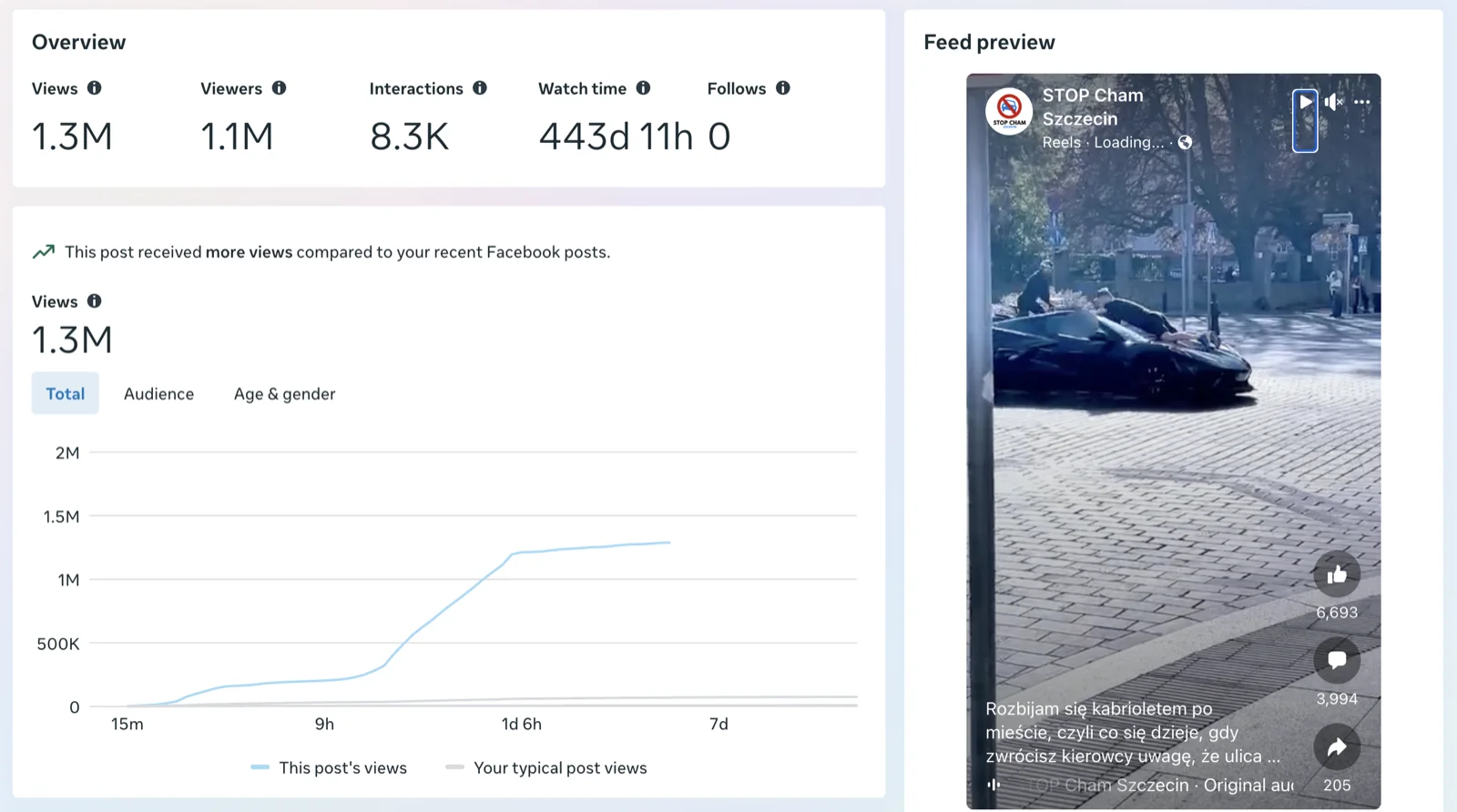
A video I posted on October 1, 2026 drew nearly 5,000 comments in four days. More than half had to be removed. Here’s what happened — and what the numbers show about online hate.
What actually happened
On a Sunday afternoon, walking down the sidewalk, I noticed two drivers racing each other on a street in central Szczecin. One of them overtook right before a pedestrian crossing I was standing on. The driver stopped with screeching tires right in front of the crossing. I asked him if he was heading to a racetrack. He answered by driving at me. From that point on, two witnesses recorded the incident on their phones. I posted one of those videos online.
I published the video on Facebook, Instagram and YouTube. Within a few hours, something started under it that can no longer be called online criticism.
The numbers
Thanks to ZenFeed, I have something most people in my situation don’t: exact data on what happened under my own posts.
Over four days, across seven related posts on four platforms, 4,931 comments appeared. More than half — 56% — had to be automatically hidden or removed for crossing the line of ordinary criticism.
| Post | Platform | Comments | Avg. toxicity (0–100) | Moderated |
|---|---|---|---|---|
| Main video | 3528 | 62.7 | 61% | |
| Main video | YouTube | 197 | 41.7 | 23% |
| Teaser post | 958 | 53.9 | 51% | |
| Reel | 86 | 49.8 | 41% | |
| Reel | 16 | 58.6 | 56% | |
| Short | YouTube | 94 | 35.3 | 24% |
| Post | 51 | 49.3 | 31% |
One thing jumps out right away: Facebook was clearly more toxic than YouTube for the exact same event — average toxicity 62.7 and 53.9 on Facebook versus 35.3–41.7 on YouTube. That’s not a coincidence. We’ve written about this before: Facebook’s network of relationships makes conflict personal — people aren’t arguing with an anonymous account, they’re arguing with someone they “know” from the same city, group, or neighborhood.
Hour by hour: what the wave looks like from inside
In the first eighteen hours, comments arrived in waves of up to 265 per hour. The peak came the next morning — 8:00 AM, the morning commute — 265 comments, 123 of which (46%) cross the 85-point toxicity threshold.
In the first 19 hours (until I manually lowered the moderation threshold from 85 to 70), the 85+ band made up 49% of all comments, the 70–84 band another 19%, and the rest (32%) was below 70. Over the following 12 hours, the 85+ band dropped only slightly — to 44% — but the 70–84 band shrank by more than half, to 7%, with the difference landing in comments below 70 (up from 32% to 49%).
In other words: the number of the most extreme comments didn’t disappear. What mostly disappeared was the “moderately toxic” layer — the one that lowering the threshold started catching as well. This coincides in time with the moment I lowered the threshold, but it’s a correlation in a single case, not proof — I’m not claiming this replicates the 30% drop in toxicity found in the study we cite on the blog. The same mechanism (less visible toxicity → less new toxicity) is a plausible explanation, but with this data I can’t isolate it from the wave simply fading over time.
No moderation team could have kept up
In the busiest hour, the main video alone received 265 comments — one every 14 seconds on average. Consider what that means for a person. Even if a moderator needs just 30 seconds to read a comment, judge it, and click “hide”, that single hour adds up to more than two hours of work. One post would need two or three people doing nothing else — and every toxic comment would still sit in public view for minutes before anyone got to it.
From the moment Facebook notified us of a new comment to the moment it was hidden or removed, the median time was 5.4 seconds. 85% of automatically moderated comments were gone in under 10 seconds, 98% in under a minute. And crucially: in the peak hour the median was 5.6 seconds — practically the same as in quieter moments. More traffic didn’t mean a longer queue.
My video wasn’t the only traffic on the platform, either. At the same time ZenFeed was moderating comments for every other client.
Those few seconds aren’t a technical footnote. A threat that’s visible for five seconds is seen by a handful of people. The same threat waiting an hour for a moderator, under a post with over a million views, reaches thousands — and some of them take it as an invitation to add something of their own.
This wasn’t “harsh criticism”
It’s easy to say “that’s just the internet” and leave it there. I didn’t. I manually reviewed the 1,154 most toxic comments on the main video and classified them under the Polish Criminal Code:
- 186 criminal threats — a declared intent to act against an identified person (“if you’d jumped on my hood, I’d have…”).
- 1,052 insults.
- 4 cases of hate speech based on race or nationality — the only category prosecuted ex officio, not on my complaint.
- 28 priority cases: threats involving weapons, threats to set a vehicle on fire, a threat of kidnapping, repeated threats to throw a victim off a hood at high speed or run them over, and an attempt to identify and name members of my family.
That last point deserves its own sentence. Someone in the comments posted the full names and profile links of people they believed were my family, suggesting they “should be properly appreciated.” That’s not hate anymore. That’s harassment with an element of threat against third parties who had nothing to do with the video.
There’s one more detail that only hits me now, looking calmly at these numbers: most of these threats and insults respond to a version of events I never confirmed — the driver’s version. People threatened me, using my full name, based on someone else’s unverified story, without trying to find out what actually happened.
Not a mob. A pile-on.
Of the nearly 2,900 people who commented on the main video, 323 (11%) came back with another comment — some many times, up to 28 separate comments from one person. That’s not the distribution of a spontaneous, one-off crowd reaction. I looked closer at this group and found two clearly different patterns.
Most of it is a burst in a single moment. 254 of those 323 people (79%) wrote all their comments within one hour — a handful, sometimes a dozen, back to back, before going back to their day. That’s the classic shape of a pile-on: someone lands on the post, spirals in the comments, then disappears. One extreme example: a single person wrote 21 comments in 16 minutes — all 21 were eventually moderated.
But 18 people (5.6%) kept coming back for more than a full day. That’s no longer a reflex — it’s someone deliberately following the post and returning to add another comment. The person with the most comments (28) wrote them over almost two days, from October 2 to October 4 — well after the rest of the wave had already died down. Their average toxicity per comment was relatively low (23.4/100), which is probably why most of those comments never crossed the threshold for automatic action (only 6 of 28 were moderated). Spread-out, “politer” persistence turns out to be harder to catch automatically than a single, highly toxic outburst.
Why I’m writing this
I’m not writing this to make capital out of my own pain. I’m writing it because I built ZenFeed precisely so that creators, newsrooms and organizations wouldn’t have to go through this blind — and because whoever goes through this rarely happens to have a tool on hand that measures it down to the hour and the comment.
Without automatic moderation, this entire wave — including the threats, the attempt to identify my family, and hate speech prosecuted ex officio — would have stayed fully public. 56% of nearly 5,000 comments disappeared before they could harm the next person reading that thread.
The case has already gone to the police and to court. That’s one track. This piece is the other: so the scale of this phenomenon stops being an anecdote and becomes something that can be measured, shown, and — I hope — put to use for more than just my own case.